One connected system for an omnichannel kitchenware retailer
Website · Klaviyo migration · Email and SMS · Loyalty · 2025–2026
Matchbox is an Australian kitchenware retailer that sells in its own stores and online. The Huntd rebuilt its Shopify website, moved its email and SMS from dotdigital to Klaviyo, and connected the rewards program, wishlist and in-store sales data so its omnichannel marketing works as one customer journey. It builds on a ten-year relationship that started with graphic design and brand, and now covers the strategy, build and day-to-day running, alongside Matchbox’s marketing manager.
2×
ADD TO CART RATE
2.5% > 4.9%
+56%
CONVERSION RATE (YEAR ON YEAR)
+70%
KLAVIYO FLOW REVENUE (MONTH ON MONTH)
85%
SHARE OF LOYALTY REVENUE FROM NEW FLOWS
In its first three months on the new Shopify site, Matchbox’s add-to-cart rate nearly doubled and conversion rate rose 25% to 56% on the same months a year earlier. After the move to Klaviyo, flow revenue grew 70% from September to October 2026, and 85% of rewards revenue came from flows that didn’t exist before.
What the business needed
Matchbox sells through its stores and online, and plenty of customers use both. The business wanted one central platform doing as much as it could, and a customer experience that holds together wherever someone shops.
That came down to three pieces of work:
• A website that supports the stores. Click & Collect had to work reliably with the in-store POS, because when it doesn’t, sales are lost.
• A marketing platform the team could get full value from. Matchbox needed one platform the team could run in-house, with every tool in it earning its cost.
• Marketing connected to the rest of the business. The rewards program, the wishlist and in-store sales all needed to feed the customer journey, with automations built around them.
The opportunity was to connect all of it, so the website, email, SMS, rewards and stores each have a role in the same customer journey.
Shopify website design and Click & Collect
Matchbox needed its website to do more than its version of Shopify allowed. The apps and custom functionality the business needed weren’t compatible with it, and Click & Collect wasn’t possible. For a retailer with stores, that matters: when Click & Collect doesn’t work, sales are lost.
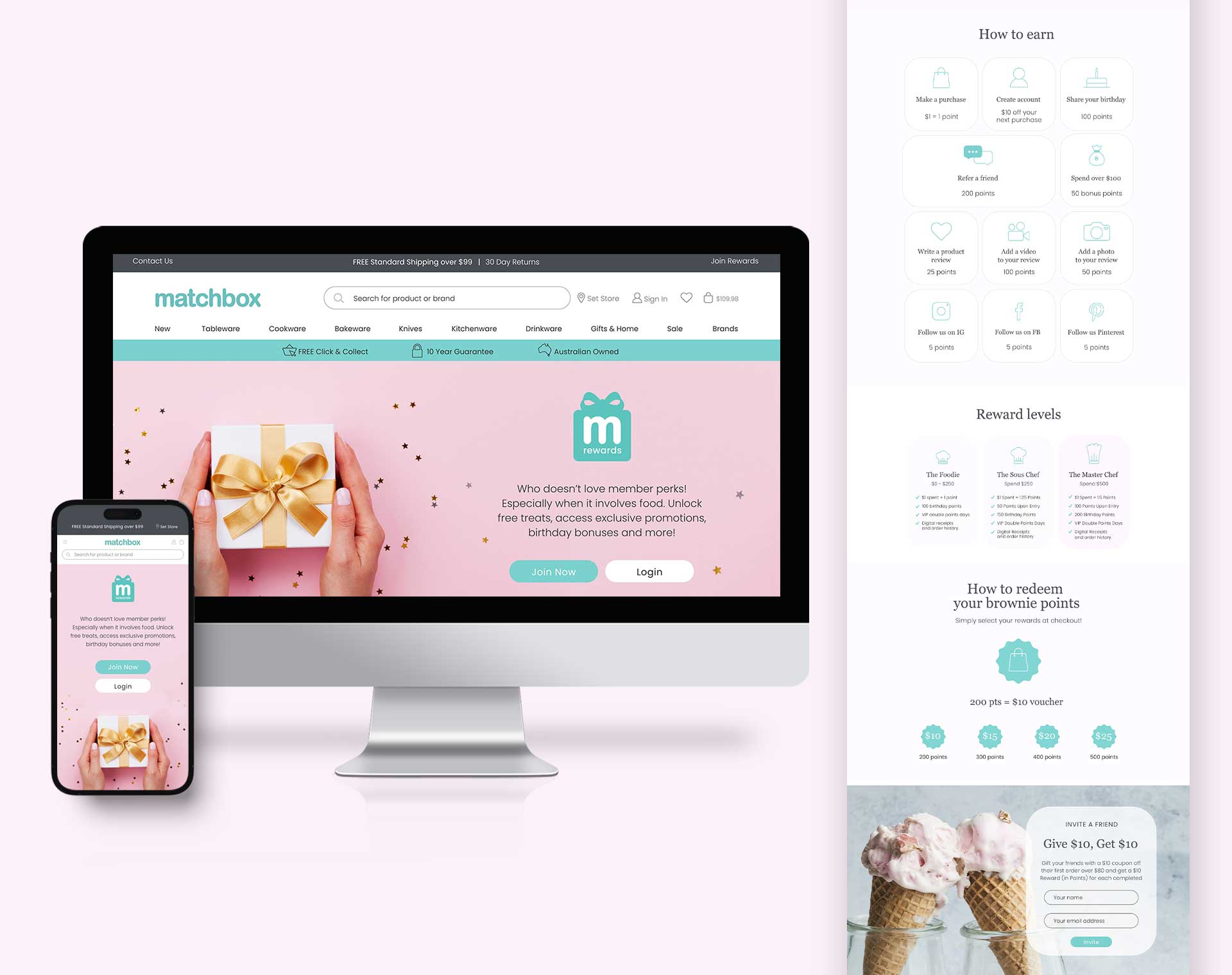
The site was designed and built from scratch on Shopify 2.0, with a conversion-first, mobile-first design.
Click & Collect was a project in itself. Shopify and Retail Express, the POS used in store, are linked through a third-party connector. Getting it working meant managing that connection with the connector partner, building a custom Click & Collect flow on the site once the connection was in place, and testing everything end to end.
Filtering now uses Shopify’s native Search & Discovery in place of third-party filter apps, with product tagging cleaned up and app conflicts removed. Navigation was simplified, and editable blocks let the Matchbox team update content without a developer.
In the first three months on the new site, November 2025 to January 2026, the add-to-cart rate went from 2.5% to between 4.0% and 4.9%, and conversion rate rose 25% to 56% on the same months a year earlier. December 2025 was the store’s best month for conversion in three years, and completed online checkouts were up 68% in November and 49% in December year on year.
Moving from dotdigital to Klaviyo
Matchbox wanted one platform doing as much of the work as possible. The previous email platform was hard to manage in-house, and an add-on tool was difficult to edit and cost more than the revenue it brought in. Customer service ran on a separate app, Gorgias.
The migration ran across August and September 2026, including a full IP warm-up across a list of more than 180,000 profiles. Shopify, Yotpo rewards and the Swym wishlist were connected to Klaviyo, so order, rewards and wishlist activity can trigger the right message. A 90-day re-engagement flow and automatic suppression of invalid addresses keep the list clean.
Email, SMS, reviews, sign-up forms, the customer agent and Customer Hub now run from one platform. With all the data in one place, messages can be personalised and targeted more precisely.
Rebuilding the flows
The audit showed the biggest gap was automation. The welcome was a single email that didn’t explain rewards to non-members, and several core flows weren’t set up at all.
The new flows are built around how Matchbox trades. Customers arrive through the stores, online and the rewards program, so entry depends on where a profile came from, with separate Store and Online welcome flows. Abandoned checkout uses value-based recovery rather than giving everyone a discount. More than 20 flows now cover welcome, recovery, rewards, re-engagement, wishlist and reviews.
Flow revenue grew 70% from September to October as the flows went live. Abandoned cart, the Store Welcome flow and browse abandonment brought in 56% of it between them.
Making the rewards program work harder
The Yotpo rewards program runs online and in store, but there was nothing to keep members engaged with it. There were no points expiry or redemption reminders, no prompt when a member was close to the next tier, and the rewards welcome was a single email.
Matchbox wanted the program simple and transactional: spend and earn. That suits an older audience, and kitchenware isn’t a category people get cult-like about, so the program’s job is to give people a reason to come back. The new rewards flows cover points expiry, redemption reminders, tier progress, birthdays and referrals. On site, customers can check their points and redeem them at checkout.
Rewards automations now bring in 21% of flow revenue, and 85% of that comes from flows that didn’t exist before. The number of customers checking their rewards progress in Customer Hub more than doubled from September to October.
Connecting in-store and online
Many Matchbox customers shop in store as well as online, so the marketing needed to see both. A custom Klaviyo metric, Placed Order (Online + In-store), combines the two, and rewards and in-store data feed into each customer’s profile. Someone who signs up in store gets the Store Welcome flow.
That flow alone brings in 16% of flow revenue.
On the website
The tools only work if customers find them where they shop. Customer Hub gives shoppers one place to check orders, track shipments, see their rewards and add products to their cart. Reviews display on site, with a review request flow offering a monthly $100 voucher draw.
Customer Hub has been opened 4,298 times since the migration, and review submissions more than tripled from September to October, the first full month of the review request flow.
What’s next
The wishlist flows are built, but not many customers use the wishlist yet. A Win Your Wishlist competition ahead of Black Friday is designed to get more people saving items, so more of them enter those flows.
The pieces depend on each other: the website has to support Click & Collect, rewards have to show up on site, and Klaviyo has to see in-store and online customers alike.
Other work for Matchbox
Ten years of brand work sits behind this project. See the window displays for Matchbox’s stores and the print and branding work.